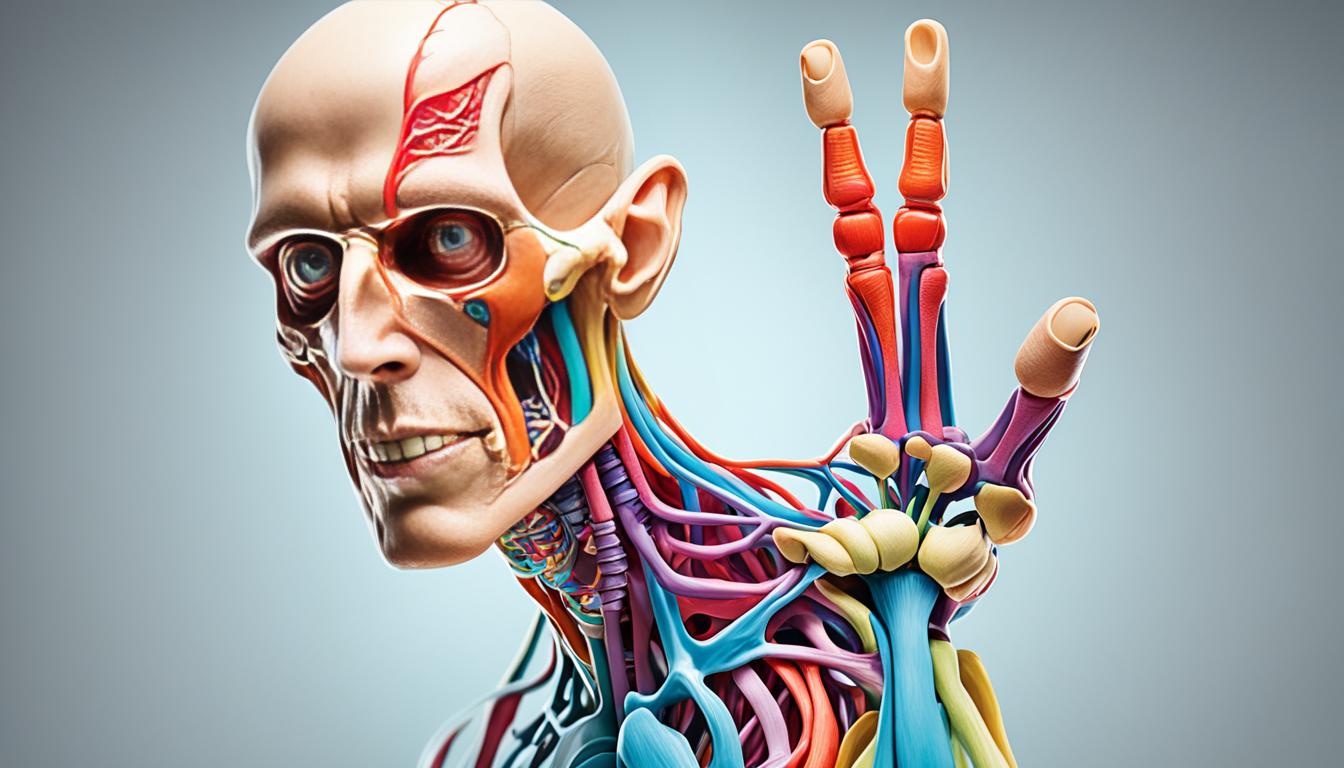
Get ready to be amazed by the incredible capabilities and peculiarities of the human form. This article will take you on a journey through unusual human body facts and quirky human body traits. You’ll learn about strange physical characteristics and bizarre biological phenomena. Prepare to discover the intriguing human body oddities we all have inside us. Let’s explore the wonders and mysteries of our bodies together.
Unraveling Unusual Facts About Our Extraordinary Bodies
The human body is a marvel of evolution, full of fascinating and unexpected surprising human body facts. It’s packed with little-known biological marvels and peculiar physiological phenomena. Our bodies are a treasure chest of intriguing human anatomy insights and captivating bodily quirks.
Did you know our skin is amazing? It has over 2 million sweat glands, each producing up to 1 liter of sweat daily. This helps keep our body temperature stable, even in extreme weather.
Our cells are incredible at regenerating. They replace old or damaged ones, helping us heal and stay healthy. This is thanks to stem cells, which can turn into different cell types as needed.
Our senses and brain are full of mysteries. By learning about surprising human body facts and little-known biological marvels, we appreciate the peculiar physiological phenomena and intriguing human anatomy insights that define us.
The Bizarre Truth Behind Goosebumps
Ever felt your skin prickle and your hair stand on end? This strange feeling is called goosebumps. It’s a mystery that scientists and people find interesting. We’ll look into why this happens and how it might have helped our ancestors.
What Causes This Peculiar Skin Phenomenon?
Goosebumps, or “piloerection,” happen because of how our body reacts. Strong feelings like fear or excitement make our nervous system do something special. It makes tiny muscles near each hair follicle contract.
This makes the hair stand up, giving us goosebumps. It’s thought to be a leftover from our ancestors. Back then, it might have made us look bigger to predators or kept us warm by trapping air close to our skin.
The Evolutionary Advantage of Goosebumps
Goosebumps are interesting, but why they happened is still a bit of a mystery. But scientists think they had a purpose. Standing up our hair could have made us look bigger and scarier to others.
It might have also kept us warm by trapping air next to our skin. This could have been helpful in cold places.
Goosebumps are still a big topic of interest for scientists and everyone else. Learning about them helps us understand how amazing our bodies are.
The Mysterious Case of Hiccups
Hiccups are common but puzzling. They are involuntary spasms of the diaphragm. The science behind hiccups looks into how they happen and what triggers them. It’s important to understand why our diaphragm contracts without us wanting it to.
The hiccup reflex starts when the diaphragm contracts suddenly and without our control. This makes the vocal cords close, creating the “hic” sound. The nerves that control the diaphragm and connect it to the brain and digestive system play a big role in hiccups.
Many things can cause hiccups, like eating too much, sudden temperature changes, stress, and some medicines. Some health issues, like GERD or a viral infection, can also cause hiccups that don’t stop. Researchers are still learning about what makes hiccups happen.
Hiccups are usually harmless and go away by themselves. But if they keep happening or come back often, they could mean there’s a health problem. By studying hiccups, we learn more about how our bodies work and react to things.
Unusual Facts: Unique Fingerprints and Their Intriguing Origins
Human fingerprints are a topic that has always fascinated scientists and the public. They are a key part of who we are and help us understand how these patterns start. Let’s explore the science behind how they form and why they’re crucial for identifying people.
Fingerprint Patterns: A Fascinating Puzzle
Fingerprints start forming early in fetal development. The ridges and whorls on our fingertips begin to appear. These patterns come from a mix of our genes and the environment around us. The way fingerprints form shows how complex the human body is, making each one as unique as our DNA.

The Role of Fingerprints in Identification
Fingerprints are also key in identifying people. Law enforcement and forensic experts use them to link people to crimes, check identities, and solve cases. They are a reliable way to confirm someone’s identity. From security systems to crime solving, fingerprints are a valuable tool in our society.
The Incredible Ability of the Human Tongue
The human tongue is amazing, doing many important jobs. It has a complex design that lets it be versatile. The science behind how it works is also very interesting. Let’s look at how this incredible part of our body shapes what we taste.
Taste Bud Diversity and Its Impact on Flavor Perception
The tongue has thousands of taste buds, each one special for a certain taste. This lets us enjoy a wide range of flavors. Scientists are still learning about how our taste buds work and affect what we taste.
The tongue does more than just taste. It helps us speak, swallow, and even control our body temperature. Its detailed structure lets it do all these things. Learning about the tongue’s abilities shows us how amazing our bodies are.
Exploring the human tongue reveals its amazing skills. From understanding taste buds to how it changes what we taste, it’s truly fascinating. Knowing more about the tongue helps us appreciate our bodies more.
Why Do We Yawn, and Is It Contagious?
Yawning is a common human action that has puzzled scientists for years. It’s interesting to learn why we yawn and how it spreads from one person to another. Scientists have looked into the reasons behind it and its role in our lives.
Researchers are fascinated by contagious yawning. They’ve found that seeing someone else yawn can make us yawn too. This might be because it helps us connect with others, which could be an old habit.
Yawning helps keep our body in balance. It involves muscle movements, breathing changes, and brain chemicals. It can happen when we’re tired, bored, or need more oxygen. This action might help us stay alert and ready for new tasks.
There’s a lot of debate about why yawning evolved. Some think it helped our ancestors stay in sync and bond with each other. Yawning could have been a way to tell others how awake or tired we were, helping the group work together better.
Exploring the human yawn reveals a mix of physical, mental, and social factors. From how it spreads to its possible origins, studying yawning gives us new insights into being human.
Uncovering the Secrets of Sneezing
Sneezing is a common and often involuntary reaction many of us experience. Have you ever wondered about the science behind it? We’ll explore the science of sneezing, the mechanisms that drive it, and its possible evolutionary benefits.
The Powerful Physiology Behind a Sneeze
The sneeze reflex is complex, starting with the trigeminal nerve. This nerve sends signals from the nose, sinuses, and face to the brain. When it gets a signal from irritants or allergens, it sets off a chain reaction ending in a sneeze.
The physiology of the sneeze reflex is fascinating. The brain sends a signal to muscles in the diaphragm, chest, and abdomen. This causes pressure to build up in the lungs, then releases it fast, pushing air and irritants out at high speeds.
There are many reasons for sudden sneezing, like dust, pollen, or sudden temperature changes. Some people sneeze when they see bright lights, a condition known as the “photic sneeze reflex.” This might have evolved to protect the eyes from too much light.
Sneezing does more than just get rid of irritants. It’s key to the body’s defense, clearing the nasal passages of harmful particles. This helps keep the respiratory system healthy and prevents illness from spreading.
The science of sneezing is full of interesting facts about the human sneeze. From its complex physiology to its possible evolutionary benefits, sneezing shows how amazing our bodies are.

The Enigma of Earwax: Nature’s Intricate Design
Earwax is often seen as a bother, but it’s key to our body’s defense. It keeps our ears safe from dust, dirt, and other unwanted particles. Let’s dive into the science of earwax and its vital role in our health.
Earwax, or cerumen, keeps the ear canal’s skin moist and safe. It comes from glands in the outer ear canal. People have different types of earwax, based on their genes. Some have wet, sticky earwax, while others have dry, flaky wax.
Earwax does more than just protect. It stops harmful germs and fungi from growing, preventing infections. It also cleans the ear by removing dead skin cells and debris.
The way earwax is made is quite interesting. The glands that make it are like those in other body parts, such as the armpits and groin. These glands produce a mix of fats, proteins, and other stuff that forms earwax.
In conclusion, earwax is a vital part of our body’s defense. By learning about its purpose and science, we see how our bodies work in amazing ways. It shows us the importance of even the smallest parts in keeping us healthy.
Exploring the Fascinating World of Knuckle Cracking
Have you ever wondered about the science behind cracking knuckles? Let’s dive into the world of knuckle cracking. We’ll look at myths, facts, and what this habit might mean for our bodies.
The science of knuckle cracking is quite interesting. Many think the sound comes from bones rubbing together. But, it’s actually the release of gas bubbles in the joints that causes the crack.
There are many myths and facts about knuckle cracking. Some worry it can lead to arthritis or harm the joints. But, studies show it’s not linked to these issues. In fact, it might even help with joint flexibility and movement.
Knuckle cracking might do more than just make a sound. It can also help reduce stress and bring a moment of calm. These findings show how complex this simple habit really is.
If you crack your knuckles or find it interesting, learning more about it can be rewarding. It shows how amazing our bodies are. From its origins to its effects, knuckle cracking is a captivating topic.
The Intriguing Mystery of Déjà Vu Experiences
Déjà vu, the feeling of knowing a situation before, has fascinated people for centuries. Scientists are still trying to figure out why we get this strange feeling. They look into different theories to understand this odd part of our minds.
One theory is that déjà vu happens when the brain’s memory system has a brief glitch. It’s like a mix-up between what we see and what we remember. This makes us think we’ve been in a situation before, even if we haven’t.
Did you know that déjà vu is quite common? Studies say up to 70% of people have felt it at some time. It might be linked to being more alert, feeling deeply emotional, or even knowing something on a subconscious level.